Amounts and timing
Ipamorelin dosage and half-life in published studies
The human timing study measured an intravenous infusion. Its clock cannot establish a personal dose or a cycle length.
The healthy-volunteer infusion study
In Gobburu and colleagues' human study, healthy men received single intravenous infusions over 15 minutes. The dose levels were 4.21, 14.02, 42.13, 84.27 and 140.45 nmol/kg, with eight volunteers per dose level. These are experimental amounts from that study. Ipamorelin has no approved human dosage.
The investigators modeled both the amount of drug in blood and the growth-hormone response. The distinction matters to me: the drug's disappearance and the body's response describe different processes, even though online discussions often compress both into a single clock.
Ipamorelin half-life and the growth-hormone peak
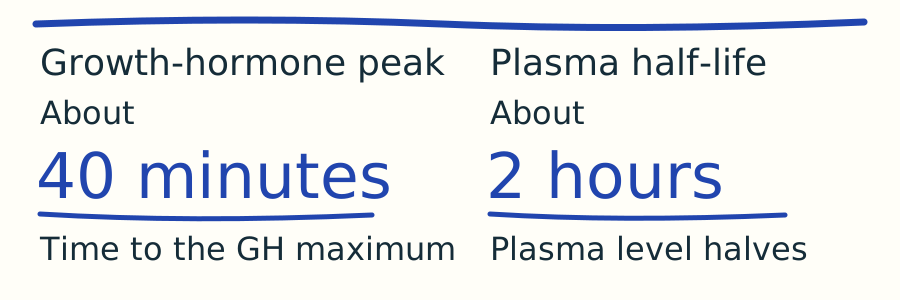
The terminal half-life was approximately 2 hours. Half-life describes the time for plasma concentration to fall by half during the elimination phase. The single GH pulse peaked at about 0.67 h, or 40 minutes, after dosing.
Clearance was 0.078 L/h/kg and steady-state volume of distribution was 0.22 L/kg. These measurements describe intravenous exposure in healthy male volunteers. They supply neither a validated subcutaneous schedule nor a duration of benefit.
For the sports-testing question, the urine-identification papers concern the detection method. Inferring a testing window from plasma half-life would ask that experiment to answer a question it never studied.
The amount used after bowel surgery
The Phase 2 bowel-resection trial administered 0.03 mg/kg intravenously twice daily for up to 7 days. The study missed its primary endpoint. Its protocol describes a supervised postoperative experiment.
The attempt to turn this failed trial into a body-composition plan makes no sense to me. The participants, route and outcome were all specific to the surgical question.
Ipamorelin dosage and cycle length
The published human work establishes no safe cycle length, no self-administration schedule and no validated dose ratio for CJC-1295 with Ipamorelin. Community protocols are anecdotal accounts rather than clinical evidence. Reports of effects fading with continued use do not establish that an on-and-off regimen solves the problem.
The phrase half-life can make a schedule sound mathematically settled. The missing clinical measurements concern me more: benefit, harm and repeated exposure in the actual population and route under discussion.
Reconstitution and preparation questions
Reconstitution means dissolving a dry powder. The available studies provide no validated human preparation instructions for Ipamorelin alone or with CJC-1295. Research-handling descriptions cannot establish the identity, strength or sterility of an individual preparation.
There is no approved Ipamorelin label with human mixing or injection directions. The safety discussion addresses why product quality adds uncertainty beyond the pharmacology.